Grades 1–2
Connect sounds and letters.
Work with short and long vowels, digraphs, blends, vowel teams, simple endings, and common irregular words. Audio-led word building helps children choose letters for sounds.
Spelling · Coming soon
HillLight Spelling is being built for Grades 1–8. Children learn why words are spelled the way they are, then use those patterns in dictation, word building, and review.
The aim is to carry a spelling pattern into a new word. Younger children build with letter tiles; older learners type, with tiles available as an accommodation.
Grade 1 starts with children who already read short-vowel words like cat, sit, hop.
Coming soon. The academic courses are in development and are not available to purchase yet.
What they’ll learn
Each level is designed around eight units: three pattern weeks and a review week per unit, with two core lessons each week. That gives 32 learning weeks plus four flex weeks for a 36-week year.
Grades 1–2
Work with short and long vowels, digraphs, blends, vowel teams, simple endings, and common irregular words. Audio-led word building helps children choose letters for sounds.
Grades 3–5
Explore syllables, prefixes and suffixes, homophones, related words, and less predictable spellings. Use dictation and short proofreading passages to apply the patterns.
Grades 6–8
Practice Greek and Latin roots, borrowed words, meaningful word parts, and frequently misspelled words. Check spellings and apply learning to new words and passages.
Spelling teaches the writing side of short-vowel patterns; it is not beginning reading. A child who cannot yet read words like cat, sit, hop should keep learning to decode first — HillLight Phonics is being built for this, or use your current phonics program.
A look inside · In development
In “Meet short a,” children notice the middle sound in “cat,” sort rhyming words, and build words from letter tiles. This practice asks for “sat,” spoken alone and in the sentence “The cat sat down.”

The child chooses the letters in order to build “sat.” Extra tiles make them use the sound pattern, rather than simply arrange every letter they see.
Later checks include words beyond the practiced list, so parents can see whether a pattern transfers to a new word.
Each unit revisits earlier patterns and includes a cumulative check. High-frequency words that need to be learned whole receive their own attention.
For parents
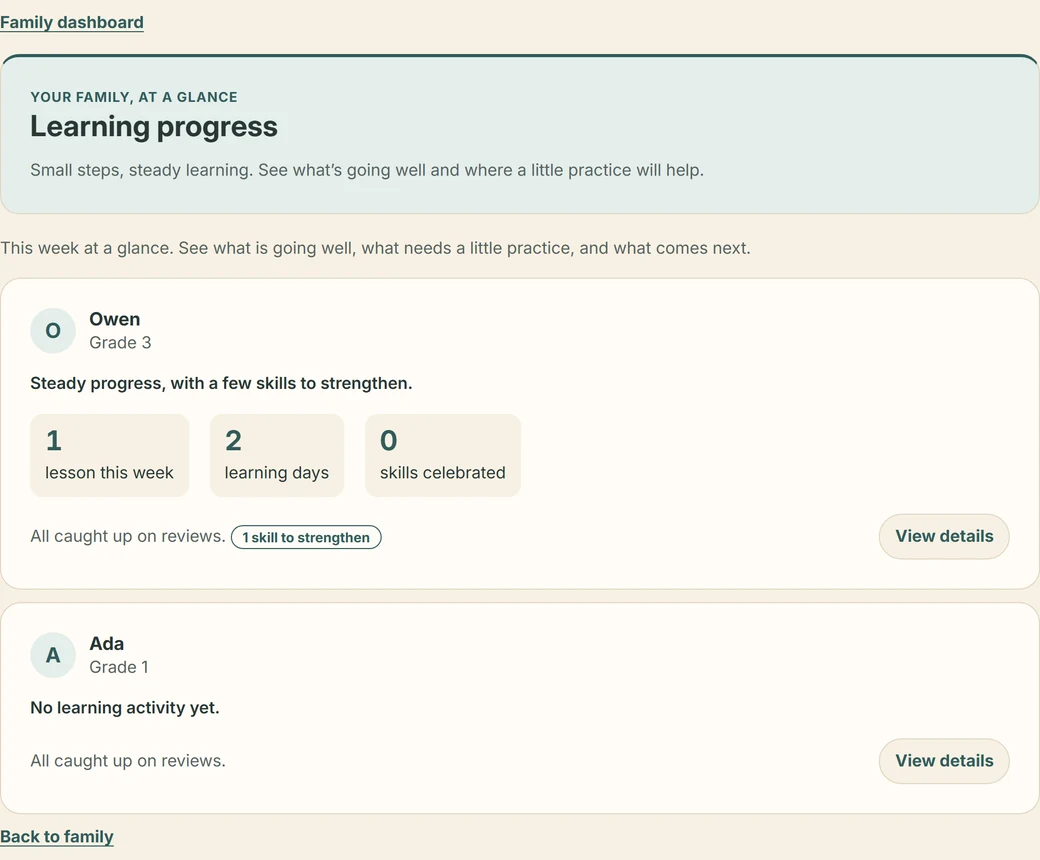
One family account keeps each child’s learning separate. The parent dashboard is being prepared alongside the courses so you can see completed lessons, time spent, and skills that need another look.
Part of HillLight ELA
$49.99 / year / family
Launch pricing covers every child and every available grade. Phonics and Early Reading, Grammar Quest, and Spelling come first; more ELA modules join the membership as they are released.
Spelling is included in ELA, with no separate per-child or per-grade purchase. ELA’s planned single-grade trial will cover released modules without a credit card. Trial access is not open yet.
Coming soon. The academic courses are in development and are not available to purchase yet.
One launch announcement. Monthly build notes are optional.
See what HillLight ELA includesParent questions
It focuses on choosing letters to spell words. Grade 1 learners should already read short-vowel CVC words such as cat, sit, and hop. A child still learning to decode needs beginning-reading support first; HillLight Phonics and Early Reading is being built for this as part of the intended launch lineup, and your family’s current phonics program is also a fine preparation.
Grade 1 uses letter tiles. Grade 2 uses tiles by default, with typing as a parent option. Grades 3–8 use typing, with tiles available as an accommodation.
The course teaches patterns and their reasons, then uses sorting, dictation, word building, and review. Children also practice high-frequency words and apply patterns to words outside the taught list.
Each level is designed for 64 core lessons across 32 learning weeks and four flex weeks. Parents can choose 2–5 learning days a week; extra days reinforce by default, with acceleration chosen separately.
No student microphone is required. They listen to dictation and respond with tiles or typing.
Spelling is in development for the initial HillLight ELA release alongside Phonics and Early Reading and Grammar Quest. Join the launch list for availability updates; it is not available to purchase yet.
Also coming first: Explore Grammar Quest. Phonics and Early Reading is also intended for launch and remains in development — see the roadmap.