HillLight Grammar Quest is being built for Pre-K through Grade 8: from listening to a
complete idea to writing and editing stronger sentences.
Short explanations, practice with support, independent checks, and later review give
each skill time to settle. Each grade builds on the skills learned before it.
Coming soon. The academic courses are in development and are not available to purchase
yet.
Original art, made for HillLight.
Grades
Pre-K through Grade 8
Focus
Grammar and language skills
Course design
36 weeks per grade
Family scheduling
2–5 days a week
What they’ll learn
From spoken ideas to thoughtful editing.
Each grade is designed as a full school-year grammar course, with about 64–72 core lessons
and room for practice and review. The content changes as learners grow.
Pre-K–Grade 1
Listen, notice, build.
Begin with complete spoken ideas, naming and action words, describing words, and
asking and telling. Pictures, narration, and simple sentence building support early
learners.
Grades 2–5
Make sentences work.
Explore parts of speech, subjects and predicates, sentence types, punctuation,
agreement, and joining ideas. Apply the skills by building sentences and editing short
passages.
Grades 6–8
Use language with care.
Work with phrases and clauses, verb forms, pronoun use, modifiers, and sentence
variety. Explain choices and apply grammar while editing more complex writing.
What each grade covers
Planned scope; lessons are undergoing review before release.
Choose a starting grade that fits your child. Children see their level called a “Trail”
in the learning app; the curriculum below is organized by grade.
Pre-K
Listening to short complete ideas; matching a spoken idea to a picture
Naming familiar people, animals, places, and things orally
Recognizing and using observable action words
Describing familiar objects by size, color, number, and quality
Building simple spoken sentences in meaningful word order
Asking versus telling; matching purpose to question mark or period
Kindergarten
A sentence tells a complete thought; word order makes meaning
Sentences begin with a capital; sentences end with a mark; the period
Naming words: people, places, things
Action words
Capitalize my own name; capitalize the word I
The question mark; asking versus telling
More than one: regular plurals
Position words: in, on, under, beside, between
Grade 1
Complete sentences versus incomplete thoughts
Telling, asking, and exclaiming sentences; matching end marks
Common nouns; singular and plural with -s
Proper nouns: people’s names and days of the week
Verbs: present and simple past
Adjectives: words that describe
Pronouns: I, me, my, you, he, she, it, we, they
Capitalization review; commas in dates and in a series
Joining words: and, but, or, so, because
Pointing words a/an/the; position words
Grade 2
Naming part and telling part: subject and predicate
Four sentence types, including commands
Collective nouns; irregular plural nouns
Proper nouns: months, holidays, places
Past, present, and future verbs; irregular past tense
Adjectives and adverbs: telling them apart
Apostrophes: contractions and singular possessive nouns
Proofreading a short passage for capitals and end marks
Friendly letters: commas in greetings and closings
Grade 3
Abstract nouns; plural possessive nouns
Pronoun case: subject, object, possessive
Subject-verb agreement
Regular and irregular verbs; simple verb tenses
Comparative and superlative adjectives and adverbs
Coordinating conjunctions; simple and compound sentences
Setting off nonrestrictive and parenthetical elements
Recognizing variation from standard written English
Editing for sentence structure and punctuation
Grade 7
The function of phrases in a sentence
The function of clauses in a sentence
Simple, compound, complex, and compound-complex sentences
Misplaced and dangling modifiers
Commas with coordinate adjectives
Sentence combining for variety
Concise wording: wordiness and redundancy
Editing for structure, modifiers, and concision
Grade 8
Gerunds
Participles and participial phrases
Infinitives
Active and passive voice
Verb moods, including conditional and subjunctive
Correcting inappropriate shifts in voice and mood
Commas, dashes, and ellipses to mark a pause or break
Cumulative editing across all domains
Choose a starting level that fits what your child is ready to learn.
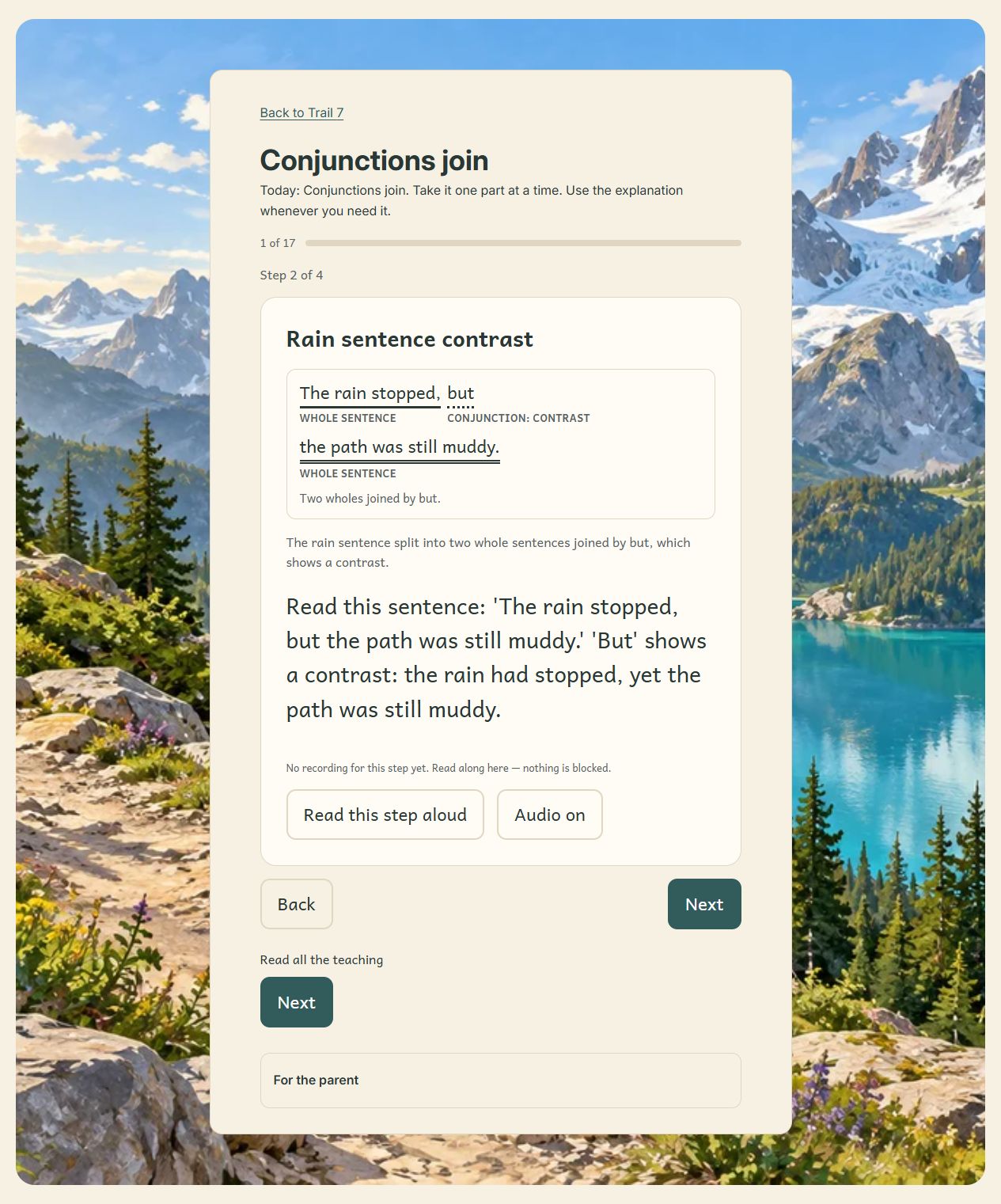
A look inside · In development
See it. Hear it. Try it.
Short teaching cards keep one idea in view. Diagrams show how a sentence works, and
illustrations support younger learners. Listen to recorded teaching or read quietly, move
at your own pace, then practice independently. Optional refreshers bring an earlier idea
back when it helps.
Actual draft lesson player. Audio is still being completed; the visible teaching remains
readable without a recording. This preview does not save answers or progress.
Then put the idea into practice.
In “Every sentence needs both parts,” a Grade 2 practice activity asks the learner to use
all six tiles: Two, young, deer, crossed, the, meadow.
Actual lesson-player excerpt from Grammar Quest, Grade 2. The learner has started “Two
young deer” and will add what the deer did. Static preview of draft content.
What this practice teaches
A complete sentence tells who or what it is about and what happens. The finished example
is “Two young deer crossed the meadow.” The word tiles let the child focus on sentence
structure before typing is required.
Learn. Hear a short explanation and see an example.
Practice. Work with prompts and useful feedback.
Check. Apply the skill independently.
Review. Return to the skill later.
For parents
Keep the next step in view.
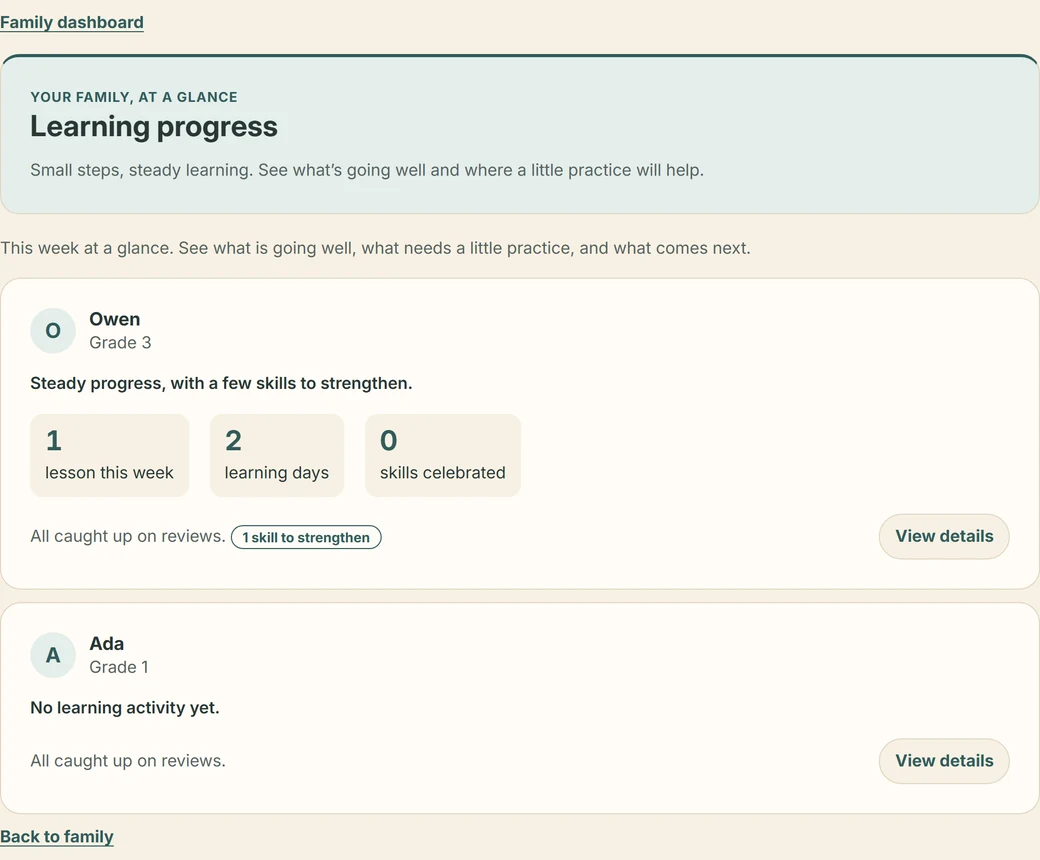
One family account keeps each child’s learning separate. The parent dashboard is being
prepared alongside the courses so you can see completed lessons, time spent, and
skills that need another look.
Choose learning days and a starting level for each child.
See lesson progress and plain-language learning explanations.
Manage weekly and monthly family progress reports.
Development preview with sample family data. Course and report release review is still
ahead.
Part of HillLight ELA
One subscription. Your whole family.
$49.99 / year / family
Launch pricing covers every child and every available grade. Phonics and Early
Reading, Grammar Quest, and Spelling come first; more ELA modules join the membership
as they are released.
When ELA opens, Grammar’s first complete unit at every grade level will be free with a
parent account. No credit card is required for that sample, and progress carries into
paid access.
Coming soon. The academic courses are in development and are not available to purchase
yet.
The Pre-K and Kindergarten courses are designed around listening, pictures, and spoken
ideas. A grown-up should help a young child get started and stay nearby.
Is this a complete English language arts curriculum?
Grammar Quest focuses on grammar and language mechanics. Reading, composition,
spelling, and the other ELA modules have their own learning paths. They join HillLight
ELA as they are released; they are not all available at launch.
Can my child work independently?
Older learners are intended to work through directions and checks with growing
independence. Younger learners will need more parent support. Actual lesson length and
support needs will vary by child.
How does the weekly schedule work?
The course is designed for a 36-week year and parent-selected 2–5 learning days a
week. Extra days reinforce learning by default; acceleration is a separate parent
choice.
Will it work on a phone or tablet?
The browser-based lessons are being built for phones, tablets, and computers, with
touch-friendly controls and keyboard access. No student microphone is required.
Can we start today?
Grammar Quest is still in development. Join the launch list for availability updates.
You can use optional Bible Memory now; it is free forever and separate from academic
ELA.